Showing posts with label Fox's Peter Pan and the Pirates. Show all posts

Wednesday, May 25, 2011

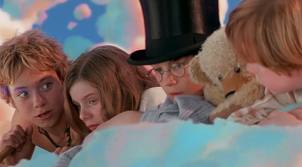
Cloudy, with a Chance of Fun

This article from The Onion blew my way from some site or another and it made me think of Peter Pan.  Imagine that.

Scientists Theorize What Would Happen If They Touched A Cloud

The line that brought to mind Pan is: While Foote claimed that a person would likely attain instantaneous unconsciousness if laid horizontally atop a cumulus cloud, opposing scientists argued that a person would fall right through.

For me, it brought to mind Peter Pan and the Darlings atop the clouds.  But you know what?  That's another movie creation.  Disney it seems.  But not entirely.  There is a case to be made for the practice of alighting on clouds in Barrie.  ...see how we bump against clouds... says Wendy, and the Narrator informs us slightly afterward: but if they saw a cloud in front of them, the more they tried to avoid it, the more certainly did they bump into it. But that's all he says.

It's quite probable that a stage production featured the children resting atop clouds prior to Disney.  Though perusing through The Peter Pan Chronicles by Bruce K. Hanson (which is devoted to the stage and screen) turns up nothing in the picture-laden book.

Though the silent movie is filled with marvelous and many F/X, clouds don't factor in at all.

It's one of the additions to Peter Pan that I do enjoy.  And not just slightly tying in to Barrie's text.  Just in general, it fits well with the mythos.

Interacting with clouds had a wonderful twist in Fox's Peter Pan & the Pirates.  Captain Hook is peering at Pan, the Lost Boys and the Darlings flying admist the fluffy white in the sky through a telescope.  He's appalled, and as I recall, says they are molesting clouds.  [Yes, he uses that word.]  Rather than looking at clouds and deciding what they look like, the kids are treating the clouds like clay and sculpting them to their whim.

In my own tales of Pan?  In Peter Pan's NeverWorld I have Amy skidding into a cloud.  In Peter Pan: Betwixt-and-Between a character brushes off a bit of cloud.  I also use clouds thematically.

It's just a fun concept, played out beautifully in Hogan's film of Pan.  Have a gander at a short couple of clips.

(P.S. - A commerical for the ThreeSixy Peter Pan aired while writing this post!)

Tuesday, May 10, 2011

100 Deux in Print

Today Andrea Jones, the illustrious author of Hook & Jill, brought an upcoming book to my attention.

For all those who are not as obsessive as we tend to be and would thus already know, this year is the Centennial of the novel form of Peter Pan.  Yep.  The second 100 year date of The Boy Who Wouldn't Grow Up.

To be precise, it's October 11.
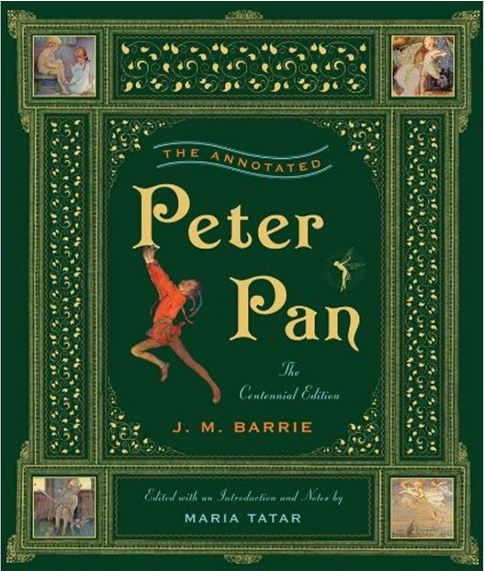
And to commemorate this grand date, W. W. Norton & Company is publishing The Centennial Edition on the very same day of the calendar.  Even better, it's annotated!

The painstaking task of annotation fell to Maria Tatar, who chairs the Program in Folklore and Mythology at Harvard University.  An author and editor quite familiar with the folklore and mythology akin to Peter Pan, it seems as if we are in for a treat by very capable hands.

I've already got my copy reserved.  But that probably goes without saying.  Here's a direct link.

Thank you, Andrea, for passing this along!  Quite the pleasure to have your pop-up plunder.

Tuesday, January 25, 2011

What Would Wendy Say?

Last night I decided to treat myself like a child.

Let me explain.

After having had such a wonderful weekend, I could finally return to the Scott Pilgrim graphic novel series. BUT - I wouldn’t let myself. Nope... not until I took care of some stuff first. You see, a few things around my place were really bothering me...or to be more accurate, the fact that I still had not done certain things around my place such as putting away the clean laundry (in which case it cluttered up part of the living area) really bothered me.

So I decided I would not be allowed to read Scott Pilgrim until I took care of it. And I really wanted to read Scott Pilgrim! Hence, I treated myself like a child. It worked. After accomplishing putting away the clothes and even a few other small tasks that I’d been negligent on, I enjoyed Volume 2 of Bryan Lee O’Malley’s world.

I’ll have to try this more often... if I can pretend that Wendy won’t let me have the adventure I want until some chore is done, I might actually wind up not hating myself for being lazy when it comes to them.

Tuesday, November 16, 2010

How to Fly?

See how the Darling children are flying here?

You know what I've often wondered?  Is that a comfortable way to fly?

I mean, really.  Parallel to the ground so that you have to lift up your head and thus risk a crick in your neck?
Not just your neck, but your upper torso often needs to be bent.  Try it out on the floor and you'll discover... no, it's really not all that comfotable.

And yet, that's the popular way to depict flying.  Not just with Peter Pan and company, but often with other flying characters such as Superman.  Why is that?  Because it looks cool?  Yes, I can see the desire to "look upon the world below" and this way lends itself to that... but wouldn't that position become tiresome?

Don't get me wrong, I'm not knocking it in the sense of  dismissing it as valid.  Likewise, I don't necessarily think that another depiction would be any better or worse.  Just curious is all...

It's also interesting to note that in most stage productions, Pan & company are upright while flying.  Naturally this results from how the flight contraptions are designed, as it wouldn't be feasible to create the 'parallel flight' on (over?) the stage.  And yet... when productions (such as film or animation) are able to produce "flight" without the visible harness and such -- the natural inclination is to do it the 'parallel' way.

What did Barrie write in his novel regarding the "flight habits" of Peter Pan?

In this ‘first’ example there is no description.

“I say, Peter, can you really fly?”
Instead of troubling to answer him Peter flew around the room, taking the mantelpiece on the way.

Later, in the same (Nursery) scene, the Darlings' attempt is put this way:
They were not nearly so elegant as Peter, they could not help kicking a little, but their heads were bobbing against the ceiling, and there is almost nothing so delicious as that.

Bobbing their heads. Hmm. If it’s true that they were parallel to the ceiling, it could be that they bobbed their heads while laying flat. But doesn’t it seem more likely that they were “standing too high” in mid-air?

When Mr. and Mrs. Darling return with Nana, looking up at the window, Barrie says:
...and most heart-gripping sight of all, they could see in shadow on the curtain three little figures in night attire circling round and round, not on the floor but in the air.

Again, no “laying flat” is stated, nor necessarily implied.  Furthermore, one does not normally think of kids circling round and round in any other way but on their feet... and the fact that it remarks that one's image of the scene needs to be "elevated" could indicate that they're upright.

Other than saying they delighted in flying around church spires and whatnot, we get just these passages about “how” they flew -

Regarding Peter:
He could sleep in the air without falling, by merely lying on his back and floating, but this was, partly at least, because he was so light that if you got behind him and blew he went faster.

Okay, sure, in this instance he’d be “parallel” - but then, that goes without saying since that’s a natural relaxed position and he’d not get a crick in his neck to do so.

Wendy says:
"And even though we became good at picking up food, see how we bump against clouds and things if he is not near to give us a hand."
To which the Narrator explains:
Indeed they were constantly bumping. They could now fly strongly, though they still kicked far too much; but if they saw a cloud in front of them, the more they tried to avoid it, the more certainly did they bump into it. If Nana had been with them, she would have had a bandage round Michael’s forehead by this time.

That one sort of implies that their heads are going 'first' but then one can argue that they'd more likely see them before running into them, outside of Barrie's humor, I mean.  However, it can also be supposed that the kicking might mean in the sense of swimming, hence horizontal.

They were now over the fearsome island, flying so low that sometimes a tree grazed their feet.

Grazed their feet? Hmm. Although it is true in the “parallel” way of thinking as well, is it as strong an argument against it? Would not their tummy scrape the trees, then - or are feet only mentioned since toes extend a little beyond?

Can we assume, then, that since Barrie specifically mentions Peter Pan on his back and had been accustomed to seeing “upright” flying in the many times he’d seen his play that Pan and others do not in fact fly ‘parallel to the ground?’

Again, I’m not suggesting that it’s wrong. Just that it could be... and thus, I wonder.  And yes, the 'parallel flying' does "look cool."  Of course, it might actually be one's natural way of doing it, since the only similar experience available is swimming, as stated before.  By the same token, though, we cannot swim forward upright, so it might be more fun to be able to do so.  Or perhaps being horizontal is just plain more exhilarating?

For the record, I did (on account of having seen it before [yes, in Disney] as well as the Superman films as a kid) picture Peter Pan and others flying that way in Peter Pan’s NeverWorld.  However, it’s also true that I envisioned upright flight as well.  Sort of an "as needed/called for" kind of thing.  It's certain, though, that I have always pictured Peter Pan hovering about for no damn good reason other than being able to do it. I even made sure to present this idea in the novel.
Rising into the air for no particular reason other than the fun of it...
Fox’s Peter Pan and the Pirates and Peter Pan no Boken also have the eternal boy “needlessly and charmingly flighty” as well.


So what do you think? How does Peter Pan fly?

Saturday, July 24, 2010

Oh Captain, Our Captain...

Yesterday I mentioned that I found something interesting regarding Peter's first nemesis, Captain Hook, in relation to him appearing in Peter and Wendy.

No, it's not some arcane extra tidbit that will unlock the riddle of his past. Rather it's just an unexpected truth. It seems that "Captain Hook" only appears once in the novel! By which I mean those two words together. And it's not even called out during a battle scene or some similar grand part. It comes at the end, when Wendy is trying to get Peter Pan to remember their (The Darlings') great adventure. Otherwise he's just refered to as Hook, or James Hook (or, of course, Jas. Hook) Hmmm.

To think... one of my favorite bits of P.J. Hogan's movie version is when Peter Pan flies in a swooping arc toward the Jolly Roger cooing out "Oh Capatain HooOO00oooOOK!" right as he's about to taunt him by zipping about and causing general mayhem. No, the scene isn't specifically in Barrie's novel, but none can say such a moment doesn't belong or didn't happen at some point in the rivalry between the famous foes. Sure, I knew the scene had been added, but I didn't necessarily realize that Pan calling out "Captain" along with Hook is 'less correct' as per the novel. For the record, I also really enjoyed such scenes as played out in Fox's Peter Pan & the Pirates.

I hope I'm not the only one who finds this a little fascinating. We're all so quick to say "Captain Hook" when in reality it's more likely that he's just referred to as Hook.

(My picture is of Hook as played by Jason Isaacs since he's by far the best [on screen.])

Friday, January 22, 2010

Have the Cape and Read It, Too

Time for another “useless secret” regarding an aspect of Peter Pan’s NeverWorld.

In my novel, Peter Pan now wears a capelet, i.e. a small cape. No, Barrie didn’t describe him with one in Peter and Wendy. So where did I get it from - and why did I include it? Even Andrea Jones, author of Hook & Jill, asked me about it during her visit.

Here’s the answer:

Truth be told, I’d rather liked the inclusion of it in Fox’s Peter Pan & the Pirates. It brought an extra certain something special to him, a neat touch out of the routine. But I knew very well that this could not be reason enough to impose it upon the eternal boy. So why else?

As can be expected, one reason for the capelet does in fact come from Barrie. In the original production of Peter Pan, or The Boy Who Wouldn't Grow Up, Nina Boucicault’s costume has something draped over Peter’s shoulders. I figured since Barrie had been involved with the show, if he objected to the small cape it would have been removed. Thus, I’d already found just cause for the addition of it in my novel.


But there’s also another reason. The very first public depiction of Peter Pan, it would seem, is art by Charles Buchel from 1904, used to promote the play before any other bit of it had been released. As you can see, Peter Pan is shown with a big flowing cape. It’s a great piece of art, but the big cape is a little much, I think. Yet it does give another reason to have Pan with something over his shoulders.

And there you have it. I really like Pan with the capelet, so I put it in the book. I of course made sure to have a line or two stating that it’s something “new” such as: Luckily she had a knack for catching hold of the capelet he’d taken to wearing.

Later on, as I learned from the recent Peter Pan at Kensington Gardens prodcution in London, it can also serve as a “reminder” of his wings from having been a bird.

My personal “rationale” for it is thus: It’s a given fact that fairies can weave cloth from leaves, as learned in Peter Pan in Kensington Gardens: … a fairy who had been gathering skeleton leaves, from which the little people weave their summer curtains… So for me it only stands to reason that eventually Peter would have clothing made from such an endeavor. (In fact, that’s precisely the case for Peter’s entire outfit in my book.) And even more importantly, I reckon that some of Peter Pan’s “mothers” (descendants of Wendy) would have left their own marks on the Neverland and sewn him some new togs.

Yet in my mind it’s not one of the “mothers” who presented him with the capelet. Nope. I have something else in mind as to where he obtained it. I don't want to reveal that just yet… as I’ve got a scene in mind for another tale on NeverWorld which will explain its appearance. Nothing major, but I think it would be more fun to find out then rather than now.

Lastly, I also knew that even with these“justifications” for the inclusion of a capelet for Pan, I had to have at least one good reason story-wise. I surely do. The lesser of these is quoted up there, when Amy Alexis Richards grabs hold of it as tries to fly away. But there’s a better reason, too. What is it? Why, it’s in the book, of course! ;)

Monday, December 7, 2009

Avast Ye! What a Weekend!

For two rounds of the sun,
me hearty and I served the Pirate Queen on deck three.

Let me rephrase that.

Over the weekend, Bart and I welcomed author Andrea Jones into our home.


I refer to her as the Pirate Queen because Andrea penned the magnificent novel Hook & Jill, which deals with not only one of the greatest pirates of them all (Captain Hook) but her own feisty female buccaneer of grand repute. You might already know from other posts (or by the whopping clue in this text) that her novel is set on the shores and waters of Sir J. M. Barrie’s fantastic isle. Hook & Jill is a “reworking” of the story of Peter Pan. Andrea played a “What If?” game with the original tale, veering it off into a grand adventure. [For more on this concept and how much I love it, see my post(s) here.] Ever since I met Andrea at her appearance at The Book Cellar, she and I have been emailing or chatting via Facebook. Eventually we realized the necessity of getting together again in person. As she had not yet seen Andrew Birkin’s The Lost Boys, I invited her to view it on our big TV. Quickly this turned into an old-fashioned “Sleepover” and we’d been planning it over a month - having set a date when both our schedules could match. Well, it finally happened this past weekend.


We had a delightful visit. Bart made Andrea’s acquaintance outside of cyberspace for the first time, and we all had a pleasant chat over the delectable vegetable soup Bart made from a recipe of one of his dearest friends, La Trix. After a while, though, Andrea and I must have driven Bart crazy with our talk of Barrie. Later on, Andrea and I watched P.J. Hogan’s Peter Pan. I bet you’ll believe that we stopped it every minute or so, eager to express our opinions. We shared which parts we deemed lovely or brilliant to what disenchanted us. I rather enjoyed Andrea’s take on certain elements, as this film is largely what inspired her to write her novel.


Later, Bart bestowed culinary magic upon us once again. A roast bone-in loin of pork marinated with orange-pineapple juice, cilantro and chipolte peppers along with baked potatoes and a mixed green salad with balsamic vinaigrette. (He’d been making dinner while Andrea and I watched the movie.) A lot more conversation ensued, and again Bart graciously dealt with our pontifications about Barrie’s masterpiece. Not that we only spoke of that subject, of course.


We had intended to watch Birkin’s mini-series, as I said. But after dinner, Bart retreated to the computer and Andrea and I remained at the table. I showed her my collection of obscure books that have to do with Peter Pan - ranging from ill conceived sequels to rare comic adaptations. Andrea had a list of items regarding Peter Pan’s NeverWorld - bits she enjoyed, questions she had, etc. We also discussed the presentation the two of us are to give next year at an author dinner in Wisconsin. (More on this as the event approaches.) Well, the next thing we knew, the bells reached three in the morning! How Time flies when you’re discussing the Neverland! Obviously we did not get to Birkin that night. But I did show/introduce her to an episode of Fox’s Peter Pan & the Pirates before bedtime. (Not to mention we realized we’d never gotten to the orange spice cake Andrea brought! {I'd been worried she would bring one of jolly thickness with green sugar on it! ;) }]


The next morning we went to brunch at a favorite haunt of Bart and I. (You might know from the dust jacket flap of my hardcover that going to brunch is a frequent activity.) When we returned, we began Birkin’s The Lost Boys. Bart watched with us, as he thoroughly enjoys the biopic as well. Andrea had been drawn in just as we had upon first viewing. But alas, we could not complete the entire show before she had to catch a train. We knew we'd have to continue the viewing at a later date. Oh what a shame - another get together. ;)


All in all, we had a marvelous visit. The long awaited “Sleepover” turned out to be as much fun as it sounded. Quite the thrill to talk shop with a fellow Barrie enthusiast. How delightful to learn more about the life and craft of a cherished author friend. Thank you, Andrea, for coming to stay with us. I so enjoyed sharing and “playing” in the Neverland with you!


Friday, August 21, 2009

I'm HOOKed.

Forgive me, but I must post again about Hook & Jill by Andrea Jones.

I am so enjoying it. For the first time, I feel like I am reading other adventures in the Neverland. And that’s quite a great feeling to have. Since I love Barrie’s island and its inhabitants so much, it’s a joy to have them in new situations and conversations. The only other time I felt this way about a Peter Pan work is Fox’s Peter Pan & the Pirates. Although this is different — this is in writing!

It may sound odd, but what made me the happiest in the book is a very simple word: the. Yes, “the.”
It’s the (ha!) placement of this little word. You see, she noticed it. None of the others who wrote of Pan did. What the heck am I talking about? In the novel Peter and Wendy, Barrie always wrote “the Neverland.” You won’t find “Neverland” without “the” before it. And Jones follows this rule. I did as well, of course, although I allow characters to say “Neverland” without “the” in front of it. It just seemed quite awkward for an entity to say “the Neverland” all the time. It made sense to me that after the expanse betwixt-and-between Peter and Wendy and Peter Pan’s NeverWorld that it would drop out of regular speech, in the way that language evolves. Perhaps I am at fault for this slight alteration, but I did purposefully make sure the Narrator kept “the” in its proper place. So, I found myself quite pleased that Andrea would care enough to notice the quirk.

I also have to say I feel slightly bad concerning something I had told her on the evening we met. While discussing the incongruity of other Pan works, I used the example of how many times Peter Pan went back to his mother’s window/house. (He went twice.) In Hook & Jill, she also writes of it being only once. However - it is also not, in this case, considerable for a contradiction of Barrie. Why? Well, it goes back to the Narrator. In the work I cited to her, the Narrator is the one who insists Pan only went once. But Andrea has Peter say so. What’s the difference? A great deal of difference. You see, Peter Pan is notorious for his bad memory. He’s also unable to discern make-believe from true for much (if not all) of what unfolds around him. But the Narrator? The Narrator knows all… or at least can be trusted to tell the truth, unlike Peter. Thus, having Pan say “once” is, in fact, still in accordance with Barrie.

In a way, but certainly not exactly or fully, it reminds me of Tom Stoppard’s Rosencrantz & Guildenstern Are Dead. This play is sort of the reverse of Shakespeare’s Hamlet. It focuses on the bit characters of R & G, as well as the theatrical troupe that performs in Hamlet. When R & G enter into a Shakespeare scene, it is instead the other characters who come into R & G’s space in Stoppard's play. In this way, we can see the effect (and affect) the events of Hamlet have on “ordinary people” as well as allow for great philosophical insights. Hook & Jill is not a direct “backstage” of the Peter Pan story by any stretch. But at the same time, it does show us other events in and around the familiar ones. It refers to Barrie’s events as having happened (such as the quick rundown of the nursery I described in the last post.) Another example: We’re given many more nights in the Underground House. It’s wonderful.

I’m liking Hook & Jill so much that I think I just might be sad when this adventure veers from the original path. Not disappointed, but sad. Then again, I don’t wish to be or plan to be. It’s just that having more of the adventures of the Neverland with the Darlings, Tinker Bell, Hook & the pirates and all of Barrie’s Lost Boys still there is too damn charming and thrilling. But with any luck, Andrea’s fertile imagination will be just as engaging.

Brava, Andrea!

Pan's at Yet Another Window...
Jones-in for More

WARNING: Hook & Jill is not a novel for children, as Ms. Jones will be quick to say herself. This adventure explores the grown-up side of Barrie’s tale.

Sunday, March 8, 2009

What's the Point?

Time for another look at a common misconception about Peter Pan.
Ever see him depicted with pointed ears? Sure you have…Disney, for one.
But does Pan in fact have this fairy-like trait?

As with the flying pirate ship and living shadow, the idea is rather charming. But as usual, I’m concerned whether the charm can hold up against what is actually written.

Peter Pan is a special boy, no question. But he is a boy, no question. In other words, he is a human child. A human child that had once been a bird, sure. But according to Barrie’s work, we all began that way. What makes Peter special is sincerely forgetting he’d become a boy, then flying back to Kensington Gardens. Once there, he’s told by Solomon Caw that he’s a Betwixt-and-Between. Neither boy nor bird.

Birds don’t have pointed ears. (In fact, birds don’t have readily visible ears.) So it cannot be his avian nature which produces the trait. And little boys don’t, normally. Hence they do not exist within Peter Pan in Kensington Gardens.

As for the text of Peter and Wendy, aside from insisting that Peter Pan is prone to putting his hand up to his ear to listen more intently, Barrie says nothing about his ears.

The story of Peter Pan and Wendy began on stage. But, the original batch of stage productions did not present Pan with elvish ears either.

Thus, it seems Disney is the first appearance.

Also note that neither TV series Fox’s Peter Pan & the Pirates nor Peter Pan no Bōken make him elfin.
Fox’s no Bōken

Of course, it is entirely arguable that since Peter spent so much time amid magic and the fairies that he acquired the trait. But for me, this answer seems like grasping to retcon.

Given Barrie’s other somewhat cryptic details about Pan, it stands to reason that he’d have mentioned something as noticeable as elvish auditory appendages.

Friday, January 30, 2009

iPan? Yes, and...

I don't have an iPhone, but if I did, I'd probably want what's on the left.
It's available on the "Text Synchronized Audiobook" application from iClassix.
How very cool. I really like the synopsis given of the story. It's not only correct, but includes many details that often go overlooked. A refreshing, insightful description of Peter Pan. (Incidentally, that link is also the purchase page. Only 99¢!)


I also found on the "InterWeb" these wacky Pan items:

Michael Sensei posted about what he calls the best known depiction of Pan in Japan. You can find his post on the Bandai series here. A little too cutesy for my tastes. But I like the leaf-construction being evident. And Hook's correct hand is intact (though he has brown hair.)

We know Peter Pan has a little of the devil in him, but jeepers! What on earth were they thinking? Peter Pan's Pantry a Flickr post by naslrogues.

Also on Flickr, Swirlyarts posted 10 envelopes depicting Peter Pan made from recycled paper. Very cool art, reminds me somewhat of Fox's Peter Pan & the Pirates. A rather unexpected look for Pan. I like it, for the most part. Hook is on the wrong hand here, though. Do have a look!

Friday, November 21, 2008

Rare Von Brownian Poetry Returns

I thought I'd share another one of my so-called poems. As I explain in the previous poetry post (alliteration!), my forte it's not. But here's another that passes for decent at least.

I also wrote this one for class. My usual haunt, but this time the focus is on the pirate nemesis. The movie that bears the title of the poem came out midway through my college years. So I wrote with some degree of excitement, as I originally expected it to be a retelling of Peter and Wendy but from the Captain's perspective. Eternal Boy, had I been wrong!
Such as it is, I much prefer my poem instead

I have an anecdote about this piece. It doesn't portray the professor of the class in a very good light, but he's no longer with the college and I hope he would be able to see the humor in it. He praised me to some degree for the poem, I don't recall the wherefores. But he ended with, "I'm just puzzled as to why it's called 'Hook.'"

You can click on the picture to read the poem. I used a picture of the Jason Isaacs version for I believe his portrayal to be the best. If you're wondering, my second favorite is Tim Curry in Fox's Peter Pan & the Pirates.

Enjoy! Rare Von Brownian Poetry

Wednesday, October 15, 2008

Take Your PIX?

So here’s what I’m wondering.
The House of Mouse’s latest “line” is Disney’s Fairies. The Tinker Bell movie is the newest addition to books and toys and such that have already been unleashed. The movie would have been out sooner, but production issues abounded. What makes me scratch my head is that according to Disney, Tink is a pixie. I’ve already expressed my displeasure at this change. There’s no need for it, really. But you would think they could stay consistent, wouldn’t you? Why, then, is it not Disney’s Pixies? Someone needs to be slapped. (Said in jest.)

What’s the difference?
You’ll of course find a great deal of mixed beliefs and characteristics, due to folkloric storytelling over the years. But there are some common, notable distinctions. Pixies are considered much more mischievous than fairies. (And Disney’s newest batch are anything but mischievous…not counting the “mean” character.) Pixies are often much bigger than fairies. They have pointed ears and wear green outfits with red caps. (Sure, Disney gave Tink a green outfit…but then, Barrie does have her dressed in a skeleton leaf.) With Disney’s drawing, it’s difficult to tell if Tink has pointed ears or if it’s just the way her hair lays. (Peter Pan does though, which bothers me. He’s not elvin.) Generally pixies do not have wings. One could argue that fairies did not always have them in stories, either. But now it’s more than a bit iconic for them to have them.

Which…would make Tinker Bell a fairy. Which she is.

So, Disney, make up your mind.

Monday, September 15, 2008

Fox's Boy Who Never Grew Up

Fox’s Peter Pan & the Pirates

For a long time this had been my favorite adaptation of Barrie’s tragic boy hero. Sure, it has some differences in character appearance from his tale, but I looked the other way because everything else had been so right. And at the time, my only “options” were Disney’s and Mary Martin’s. The silent movie hadn’t been readily available. I have a theory as to why the discrepancies existed. I believe they wanted to differentiate from Disney’s. And much of it has to do with…color. For instance, Captain Hook has black hair (in Barrie’s and Disney’s.) Disney shows him in red. Wendy is in blue. Tinker Bell is in green. And Peter Pan himself also wears something green. According to Barrie he is “clad in skeleton leaves and the juices that ooze out of trees.” Now note the difference: Fox’s Hook has white hair and he is wearing dark blue. Wendy wears pink. So does Tink. And the eternal boy? In brown. It seems like they wanted a complete contrast to make it their own. For the most part, those are the changes. Otherwise, they took Barrie’s text seriously. They even list the title correctly in the opening sequence: A new and independent series inspired by J.M. Barrie’s original novel “Peter and Wendy”

Like the Japanese series Peter Pan no Bōken that predated it (which I had no knowledge of then) Fox’s animated television series is based on this part of Peter and Wendy: Adventures, of course, as we shall see, were of daily occurrence... To describe them all would require a book as large as an English-Latin, Latin-English Dictionary, and the most we can do is to give one as a specimen of an average hour on the island. A simple, yet rich with potential idea for a TV show. How wonderful to be able to experience more Peter Pan adventures without straying from the story. I enjoyed this series. Quite a bit. As I said, it provided the best Peter Pan I’d ever seen.

Unlike no Bōken, however, there is no semblance of a story arc to this show. It's simply a series of separate adventures. It's not a Finite Cartoon.

The deliciously wicked Tim Curry lent his voice to bring Captain James Hook to life. He had a particular way of saying “boy” that tickled me. It conveyed the pirate’s grumbling and annoyance with Pan quite well. He won an Emmy for his performance.

And I’m happy to say that Peter Pan is portrayed just right, too. Cute, cocky and unconcerned half the time. Plus a lot of “pointless” mid-air hovering around. I described this in my post about no Bōken. (Here you will find a Peter who stands on a ship’s mast and appear to fall only to quickly zip-curve around behind you. A Pan who sits crosslegged in midair. A Peter who jumps down and falls fast, then slow, then throws out his arms and legs and darts off another way. ) As I said in that post, no Bōken does it better, actually. But when I’d been watching Fox’s it had been the first time I’d been exposed to the idea, so it delighted me greatly.

What I admired most about Fox’s effort is their ability to create new characters and places which seemed quite Barrie-like indeed. The place name that springs to mind is Small Monday Island. As I recall, it’s sort of a fair for fairies and gnomes and the like. Small Monday Island…what on earth does it mean? Not that I actually want to know. It has the Barriesque quality of sounding logical and for-certain yet being born of gibberish and ambiguity. The character who springs to mind is…well, it’s a tie. Either Uloch the troll or King Kyros, Lord of Ice. Uloch feels incidental…as if he’d always been there and you just never noticed. And Kyros’ irritation with Peter boy added to the idea he is often an unwelcome troublemaker. “Stop this pitiful nonsense, Pan!” I remember being very happy that he just called him Pan. There is also a new Indian character worth mentioning. A boy named Hard-to-Hit.

There are few bizarre additions, such as the episodes with the Girl in the Moon and a brother, Captain Patch, for Hook. But they are not offensive to Barrie’s work, just a bit more jarring than the rest of their creations.

They also oddly portrayed the Twins. In their version, one is tall and the other is short. One is dark skinned and the other fair skinned. But they’re inseparable and seem to have one mind. They will finish each other’s sentences. Barrie explains that Peter never quite knew what twins were. So, perhaps…just maybe…Peter’s lack of knowledge resulted in him believing their situation to be Twins. That’s my answer for it. Again, I found myself willing to let the oddity slide amid all the rest of the accuracy.

In the final two-episode, Ages of Pan, Fox practically crossed a line. Peter Pan captures Hook and has a large device that will shoot spears at him. In an effort to save his life, Hook makes a speech with complete serenity and control of thought. He does not plead for his life to be spared. Rather he tells Pan that he may be killed - for he has had a full life. He has been a youth, an adolescent, a young man and an adult. Unlike Pan. Something Peter can never do. Not to be told he can’t do something, Peter Pan lets him go. He begins a new game - growing up. But it’s no game. For true and make-believe can be the same for Pan. He starts to age. Okay, now, see, that’s just not right…but they made it compelling… believable. Instead of simply making him a disgruntled lawyer with parenting issues, they showed his agonies and grief at forgetting his fun as a child. At odds with the strangeness and the yearning to know his identity. The Neverland dies around him. And considering that one of Barrie’s own fascinations had been what on earth the old age of Peter Pan would be…Fox gave us their spin on it. At the end of the episode he is an old man, with a long white beard. It takes the love and words (and single tear) of Tinker Bell (who is barely existing herself) to restore him. A bit hokey, perhaps. But when held up as a parallel to Peter Pan asking that Tink’s life be saved, it’s a touching moment. Don’t worry. Peter returns to his normal self. As with everything, Fox handled it the situation with great care.

Despite the risks it took and the small changes it made, Fox’s Peter Pan & the Pirates never seemed to leave the world of Barrie. His mocking logic and child-like playfulness always flew along, like wind keeping the stories aloft.

Sure, some episodes are leagues better than others. But that’s always the case.

The series lasted for 65 shows.
It premiered on September 8, 1990. The last air date: December 2, 1991

The picture is the first I had seen of the show.

The Silent Boy Who Never Grew Up
Japan's Boy Who Never Grew Up
P.J. Hogan's Boy Who Never Grew Up
Disney's Boy Who Never Grew Up

Sunday, July 20, 2008

Japan's Boy Who Never Grew Up

Peter Pan no Bōken (Adventures of Peter Pan) is a Japanese cartoon series based on…well, you know. I have long known about this TV show (which ran in Japan over the course of the year 1989) but being able to see it proved a bit difficult. Then the magic of the internet came along. Which means I caught glimpses of it on YouTube and other sites. I resisted delving into it. Somehow I did not fully trust it to be a worthwhile adaptation. The skeptical side of me always won out. Until now. I recently came across a site harboring half of this 41 episode series, with English subtitles. I will not link to where, for it’s probably not “right” that they are online.

I must say that I am not a fan of the character design. I’m sure there are many traditions being drawn upon here. But it is just not to my tastes. [Though the Captain’s hook is on the correct hand!] I just don’t like the way the characters look. But I did not let that stop me from watching the show.

As it turns out, it is very much a forerunner to Fox’s Peter Pan & the Pirates. (I wouldn’t be surprised if Fox procured the idea.) Fox’s show I enjoy very much. More on that series some other time. But no Bōken proved to be just as appealing, despite the character design. However, it does veer from the original story in many ways. Normally that would bother me greatly. But on this front I am not entirely an ogre. After all, they are changing the medium of the tale. When that happens, rearrangements are often necessary. Among other alterations, they subtracted some Lost Boys, gave them a house amid a tree (calling to mind the Wendy house in the treetops at the end of Barrie's, of course, although they are supposed to live underground for the main text) and added a lot of extra story. In fact, it doesn’t even begin in quite the same way. Sure, Wendy is hoping that Pan will show up at her window. But here she and her brothers are dreaming about him, researching him in a book store, eating breakfast with the family and such. Later on, the final battle with Hook is a grand adventure through a booby trapped mountain (which is much better than it sounds).


The entire premise for the show revolves around the fact that the Darling children had many adventures in the Neverland that did not make it to the page. Adventures, of course, as we shall see, were of daily occurrence... To describe them all would require a book as large as an English-Latin, Latin-English Dictionary, and the most we can do is to give one as a specimen of an average hour on the island. Thus, creative folk have plenty of room for imagining other escapades. What struck me, though, is the time devoted to showing everyday life in the household. Besides being used as petty, cute filler until the adventure begins, whole sections give us the amazement of the Lost Boys at seeing Wendy-Mother making breakfast, washing dishes, sewing, etc. In short, it drives home the very notion of Home. It truly accentuates the irony that for these castaway boys surrounded by countless fun, the true curiosity and hold is what would have been mundane had they stayed on the mainland.

I loved how Peter Pan himself behaved. Not just his personality which they hit spot on, but his movements. Here you will find a Peter who stands on a ship’s mast and appear to fall only to quickly zip-curve around behind you. A Pan who sits crosslegged in midair. A Peter who jumps down and falls fast, then slow, then throws out his arms and legs and darts off another way. From his wayward flight paths to his subtle floats, his lovable obnoxious demeanor is beautifully translated by the writers, animators and voice actor. I should mention that this kind of attention to his, well, flighty motions happen in Peter Pan & the Pirates, too. And I adored them in it. But I noted that the Japanese did it first, and better. For those of you who will say that Disney’s Pan did this even before no Bōken, I say: Yes, true. But for me, not in quite the same way. I think no Bōken and Fox’s depiction of the controlled recklessness is far superior.

One aspect I found curious is the inability of anyone to fly in the Neverland except Peter Pan (and Tinker Bell, of course). A reason is given: Because in the Neverland there are too many other fun things to do than be able to fly. A trumped up reason, if you ask me. But I went along with it on the grounds that it proved a wonderful way to create tension and adventure. For instance, one cannot just fly across a raging river…one must brave jumping along the stones poking out of the water. But then, by the same token, Fox’s had them all flying and managed to create danger and excitement. However, no flying worked for this version.

I enjoyed their other interpretations as well, like the Neverland being an island in the sky. It’s easier to show you a picture:

It’s not correct, of course, but again, it’s a new way for a cartoon adaptation.
Rascal the Raccoon: another fun addition. Others exist, to be sure, but I won’t list them all.

I found myself loving this series. I truly wish to see the second half, especially since they introduce more characters, like an evil sorceress as a villain once Hook is gone. For those of you know me well, a pleasing Peter Pan is something of a rarity. Amazingly I like it even better than Fox’s. It does have foibles, but on the whole it captivated me. But I think Peter Pan no Bōken captures Barrie even more.

If you can find it, do give it whirl. I recommend it.
If we could combine the two shows into one? Dare to dream.

Disney's Boy Who Never Grew Up
P.J. Hogan's Boy Who Never Grew Up
The Silent Boy Who Never Grew Up

Fox's Boy Who Never Grew Up
...return to Japan's version of the Neverland
Peter Pan no Bōken - Not Entirely Broken