I asked Bart a question regarding the story of Pinocchio. It had probably been in comparison between the real thing and Disney. Bart had at least part of the answer, but promptly reported that he did not so much care for the original story as the little wooden boy proved way too awful for him when he had tried to read it once upon a time.
To the internet! As I suspected, Project Gutenberg came to the rescue... and I began to read The Adventures of Pinocchio by Carlo Collodi. I’m kind of appalled. Not just by the unexpected horrid events in the story, but by the quality of the story itself.
Bart told me (and the internet confirmed) that it had been written as a serial at first - and Bart suggested the “made it up as he went along” as a probable “excuse” for the writing.
What got my goat? Well, the work is entirely off the wall for one thing, but more importantly, the narrative doesn’t seem to care one whit about logic. No, I don’t mean the fantastical elements of the tale such as a living marionette and a talking cricket. I’d been put off by the seemingly sheer disregard for sense and cohesion. For instance, at one point our mostly naughty protagonist comes across chick peas when he is very hungry (he’s very hungry quite a bit!) and we are informed that Pinocchio has always hated chick peas. How does he know when he’s never come across them before in the story? (Yes, we’re given blow-by-blow of his eating habits.) Oh sure, you might want to chalk it up to a kid turning his nose up at the sight of something but consider that it’s not written to be construed as such. And I suppose a previous tasting could just have been left out. But if that’s not enough to convince you, other such "abrupt absolutes" exist such as the fact that Pinocchio, on his own, without having (yet) gone to school or having been taught by Geppetto (who, by the way, has at this point in the story landed himself in jail because the townspeople fear for the puppet’s life given his horrible temper) knows not only what an egg (by name) is when he finds one, but what an omelet (and other cooked forms) is as well as the procedure on how to produce said entrée. In fact, he knows all sorts of words and concepts right off the bat. Perhaps I am over reacting, as it is a children’s story and what does it matter? Two responses to that... first, it matters because it is one of many apparently careless absurdities mounting in an non-ignorable pile throughout the story up until then (and beyond) and I should like to think a child is more discerning than that. I, at least, had been, and know many

other kids whose reaction to such occurrences in stories would be similar. It did not, you see, have a charming nonsense to it as one finds in the Carroll's Alice tales, nor does it have a self-contained indiscernible logic to it like Barrie’s telling us that fairy dust makes one fly. And that second response? Well, I’ll get to that in a bit...
Another disturbing factor in
The Adventures of Pinocchio is that Bart had pretty much been correct. You may think Peter Pan is a horrid boy but at least he’s not throwing a hammer (and thus killing) an innocent talking cricket at his first encounter with one. Yes, he kills the (unnamed) cricket... sort of... the cricket comes back as a ghost and then at the end it appears as if (rather confusingly and ambiguously) that the cricket had only been pretending to be dead. But still, who would have thought that Pinocchio throws at hammer at the ‘beloved’ insect character because he doesn’t like that he’s told he’s a bad boy?
Pinocchio is bad from the start. As Geppetto is making him he kicks the old man. Oh... the blue fairy that comes to bring him to life? Forget about her for now. She doesn’t show up until halfway through the book, so no, she’s not the one who bestows life on him at Geppetto’s wish. (Geppetto never makes any such wish, actually - he creates him to make money performing with him. And furthermore, Pinocchio doesn't seem to care about being a real boy until three-quarters of the way through the story either.) When he makes the mouth, Pinocchio instantly laughs at and insults him...when told to stop, he pokes out his tongue. Perhaps you’re wondering Geppetto’s reaction to his creation being alive as he makes it? So am I. There really isn’t one except for him thinking he deserves it...but otherwise, inexplicably, he just accepts it as it happens. In fact, NO ONE in the story is wide-eyed at a living marionette. Not the townspeople, the police, nor the Fox and Cat, the (alleged) evil puppeteer, the kids at school nor the teacher, Lamp-Wick, the fisherman... no one. Furthermore, it just seems to be a fact of the story that marionettes are alive. Indeed, the other puppets in Fire Eater’s (yes, that’s his name) theatre are alive. With no strings. Folks, Disney added that concept! In another example of the horrific nature of the story, Fire Eater wants to cook his dinner so he’s about to throw Pinocchio on the flames. Our dubious hero’s ramblings about his poor old father that he wronged who will be left all alone (which seems to be not so much actual concern as clever manipulation since he otherwise appears to hate Geppetto) and whatnot cause Fire Eater to spare him, so Fire Eater decides to use the Harlequin marionette (as throwing living puppets on the fire is a routine occurrence with his troupe) but then in another example of out-of-the-blue absurdity Pinocchio protests that he should be used in place of his best friend. Best friend? He met the other puppet naught but a scene ago! What’s more, the other marionettes recognized Pinocchio by name without ever having encountered or hearing of him before.
Other notable “whoa” moments: Pinocchio’s feet are burned off. He is hanged. He’s jailed (for being a victim of robbery and released four months later for admitting he’s also a thief.) Laughing at Pinocchio tripping, a serpent bursts an artery and dies. Pinocchio is forced to be a watchdog, complete with a collar/leash and little doghouse. Unlike Disney portrays, Pinocchio fully becomes a donkey at the place of pleasure [translated here as the Land of Toys], is sold and made to perform in a circus - only to be become lame and thus re-sold, then drowned for the purpose of taking his skin to make a drum but the fishes eat off his donkey flesh and he’s a puppet boy again.
So there you have it, the story is filled with an unforgiving strangeness, all wrapped up in an overly heavy handed moral. It’s fine to have morals and lessons in a story but these are all too directly stated. And relentless. (As in every other chapter.)
Okay, sure, kids might like this kind of thing, right? Well, I said I’d get back to that and here ‘tis: The Adventures of Pinocchio had not been intended for kids. Well, half of it anyway. Collodi deemed the story over at the part where Pinocchio had been hung and he meant it (a la that overbearing moral) to show what a gruesome end one comes to for being disobedient. Someone encouraged him to write more, however, and that it could be a tale for children. Apparently children’s literature had been a brand new idea in the early 1880’s. Thus, he continued it and the Lady/Fairy with Blue Hair [who claims to be dead, by the way] saves Pinocchio. From then on the “Blue Fairy” is part of the narrative (but it’s not her that makes him a real boy.)
I suppose we can “forgive” the tale for its ill-crafted non-sensibilities given that children’s lit had been fresh out of the gate. But still, it just makes my skin crawl that someone writing a story would not pay attention to details. I did suspect that the story had been meant as a tongue-in-cheek comedy, probably even a dark comedy. But even on that level I don't see how it would have been engaging for an adult.

There are reportedly two (at least two) new movie adaptations of the little wooden boy coming to the big screen...and I’m curious how they’re going to handle it. After I read it, Bart and I watched the 1996 version starring Martin Landau and Jonathon Taylor Thomas. Not so bad, actually, but it resembled the original story only vaguely and loosely with plenty of MAJOR rewrites along the way, which, as evidenced, might not be such a bad thing. And Jim Henson productions really came through with some amazing spectacles.
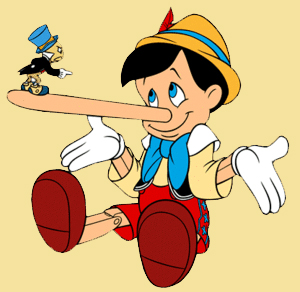
I’ll tell you, though, this is one tale that Disney improved! But even theirs had a heavy-handed, beat-the-horse-dead moralistic tone to it. Curiously, though, they only have Pinocchio’s nose grow once in theirs... it does happen a few times in the original. (There’s even a scene where he cannot get out the door because his nose is so long [of which by the way, I fail to fully grasp the logic.])
So, once again, we have a tale that is completely overshadowed by the erroneous perceptions and elements thrust upon the original by others. A story that everyone thinks they know by heart - but truthfully "no one" really knows the half of it. Normally I recommend reading the real thing... but this one seems best when letting someone else pull the strings.
From the mouth of a puppet.


 quips. Truth be told, I am also rather fond of the bit they added that (it often seems) has become ingrained into the story: the flaming Jack-O-Lantern thrown through the covered bridge. It’s just so appealing and if thought of in the right frame of mind is actually kind of terrifying. The best part about it, though, is that it’s not entirely foreign to Irving. At the end of his story we’re told all that had been found left remaining of poor frightened Ichabod had been his hat and smashed pumpkin. It pleases me that they were able to take part of the story and expand on it so well.
 quips. Truth be told, I am also rather fond of the bit they added that (it often seems) has become ingrained into the story: the flaming Jack-O-Lantern thrown through the covered bridge. It’s just so appealing and if thought of in the right frame of mind is actually kind of terrifying. The best part about it, though, is that it’s not entirely foreign to Irving. At the end of his story we’re told all that had been found left remaining of poor frightened Ichabod had been his hat and smashed pumpkin. It pleases me that they were able to take part of the story and expand on it so well.
 menace. However, there’s also a part of me that likes to imagine him as realistic as possible, as in wearing the traditional uniform of a Hessian soldier from the Revolutionary War era.
 I also want to point out that aside from Disney's flaming pumpkin, this is another tale that years of retellings have embellished to the point of people often thinking certain parts are in fact in part of the original - such as Brom actually dressing up like the Headless Horseman to scare Ichabod [prior the real Horseman showing up later.]



 Posts
Posts


